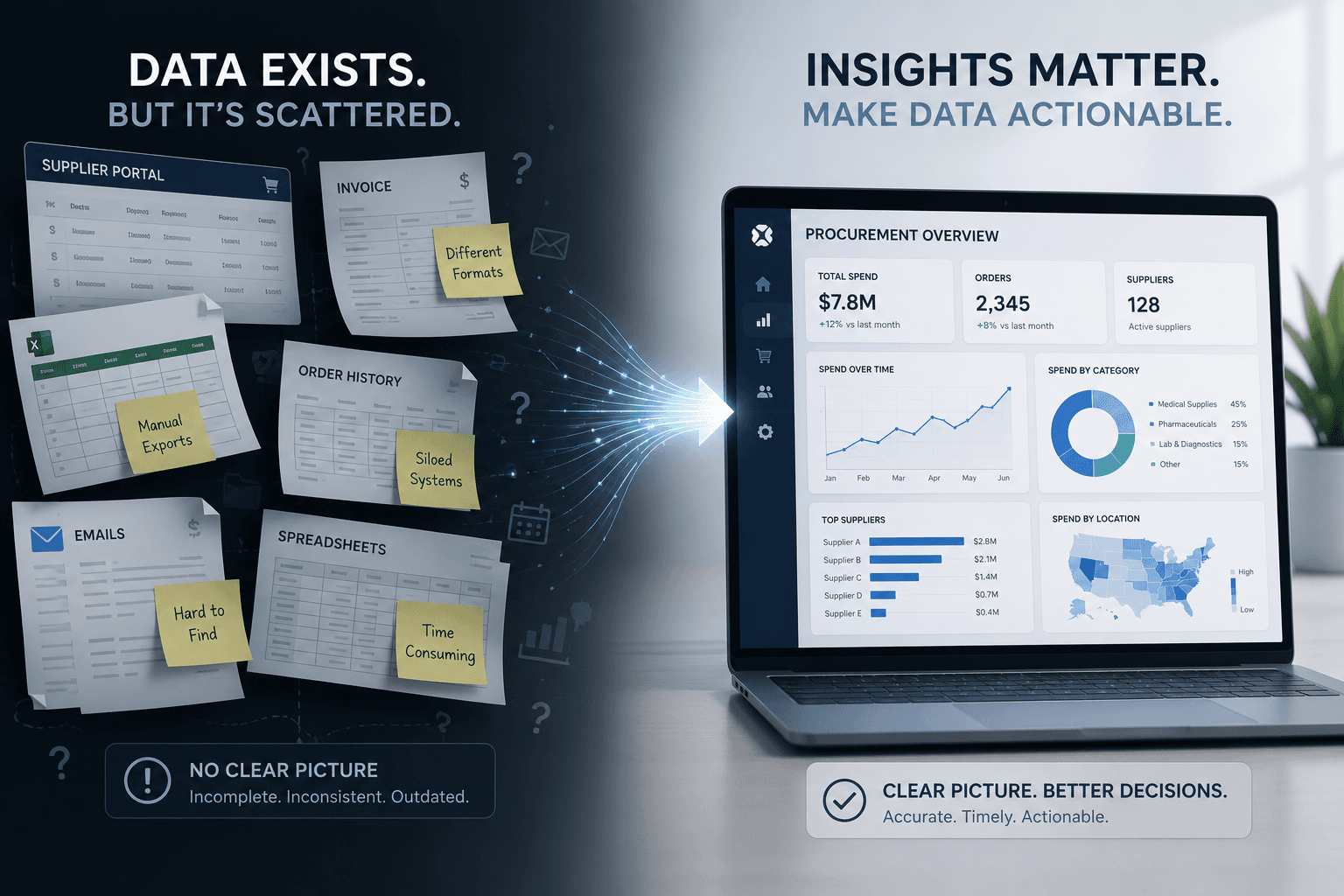
The Hidden Cost of Managing Multiple Supplier Portals
Most healthcare organizations do not buy from one supplier.
They buy from several.
One portal for medical supplies. Another for pharmaceuticals. Another for laboratory products. Another for specialty items. Another for office or facility supplies.
On the surface, this seems manageable. Each supplier has its own website, login, order history, and invoice process.
But over time, the complexity adds up.
The cost is not just the products being purchased. The cost is the process required to manage them.
Each portal creates another workflow
Every supplier portal has its own structure.
Different logins.
Different product searches.
Different order histories.
Different invoice formats.
Different reporting tools.
Different approval processes.
That means staff members must constantly switch between systems to complete routine purchasing work.
The more suppliers an organization uses, the more fragmented the workflow becomes.
Fragmentation creates mistakes
When purchasing activity is spread across multiple portals, it becomes harder to maintain control.
Employees may duplicate orders.
Products may be ordered from the wrong supplier.
Invoices may be difficult to match.
Managers may not know who placed an order or which location requested it.
These small issues can create real administrative burden.
In healthcare, where teams are already busy, purchasing mistakes are more than inconvenient. They take time away from higher-value work.
Reporting becomes harder than it should be
Supplier portals are usually designed to show activity with that supplier.
They are not designed to show the full purchasing picture across every supplier.
That creates a reporting problem.
An administrator may need to log into several portals, export data, review invoices, and combine everything manually just to answer basic questions:
How much did we spend last month?
Which location ordered the most?
Which products are increasing in cost?
Which supplier are we using most often?
Who approved this purchase?
These should be simple questions. In many organizations, they are not.
Time is the hidden expense
The biggest cost of multiple portals is often time.
Time spent logging in.
Time spent searching.
Time spent reconciling.
Time spent answering questions.
Time spent building reports.
Time spent fixing mistakes.
Most organizations never calculate how much staff time is lost to fragmented purchasing, but the impact is real.
If a process happens every day, even small inefficiencies become expensive.
Healthcare teams need one view
Supplier portals are useful for placing orders, but they do not solve the broader procurement challenge.
Healthcare organizations need one place to see purchasing activity across suppliers, locations, users, and categories.
They need visibility.
They need control.
They need reporting that does not require manual work.
The future is not about replacing supplier relationships. It is about making those relationships easier to manage.
Healthcare organizations do not need more portals.
They need a better way to manage all of them.