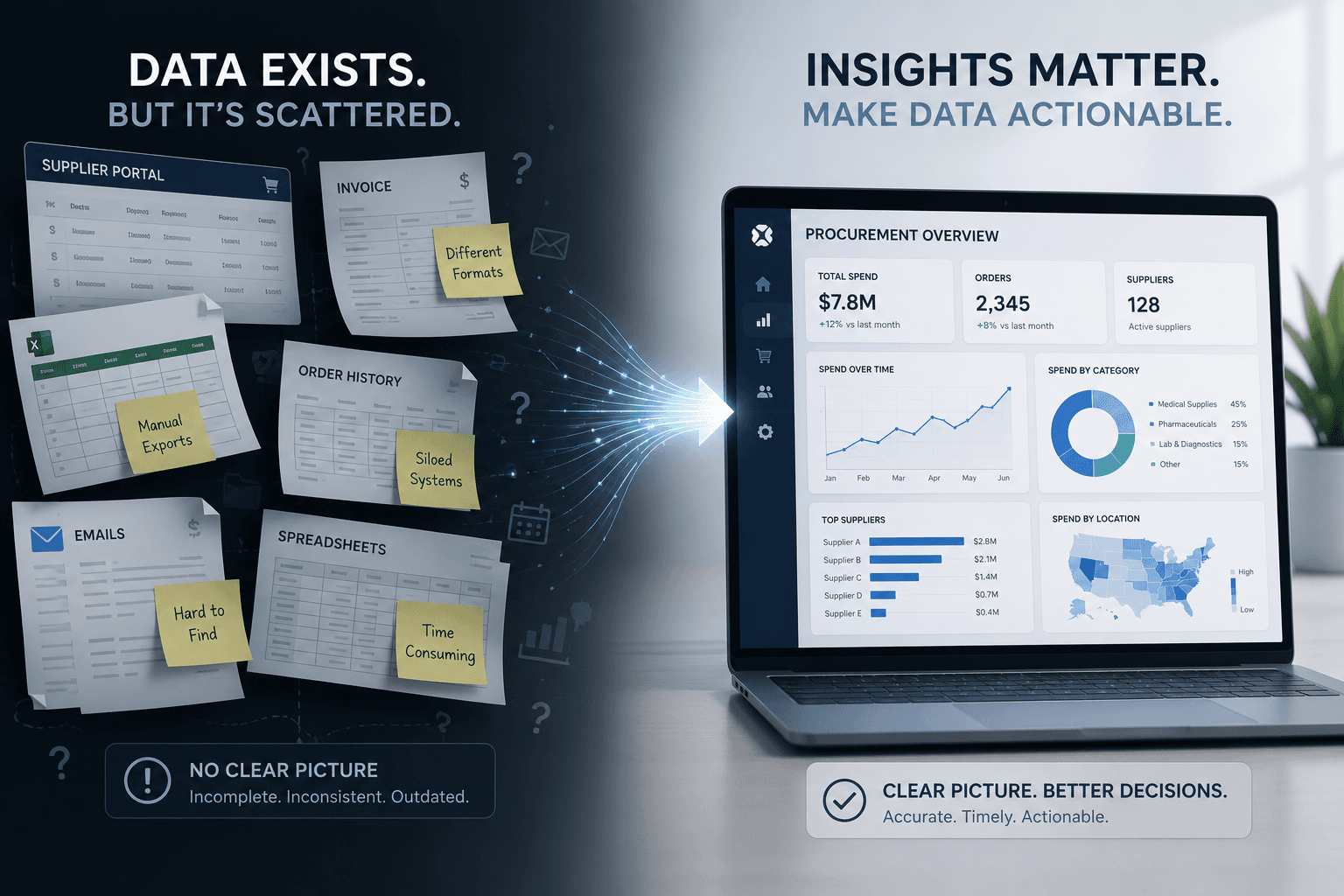
The End of Manual Procurement Reporting
Procurement reporting should not be a monthly project.
But in many healthcare organizations, it still is.
Someone exports data.
Someone reviews invoices.
Someone updates spreadsheets.
Someone formats a report.
Someone sends it to leadership.
By the time the report is ready, the information may already be outdated.
That is the problem with manual reporting.
It slows down decision-making and takes valuable time away from the people who already have too much to manage.
Manual reports are hard to maintain
A procurement report is only useful if the information is complete, accurate, and current.
That is difficult when purchasing data lives across multiple supplier portals, accounting systems, spreadsheets, and inboxes.
The more suppliers and locations an organization has, the more complicated reporting becomes.
Small errors can easily enter the process.
A missing invoice.
An outdated export.
A duplicate entry.
A product placed in the wrong category.
These issues may seem minor, but they affect the quality of the decisions being made.
The work is repetitive
Most procurement reporting involves the same work again and again.
Collect the data.
Clean the data.
Organize the data.
Format the report.
Explain the numbers.
Repeat next month.
This is exactly the type of work modern software should reduce.
Healthcare teams should not need to spend hours assembling information that a platform can organize automatically.
Leaders need answers faster
Procurement questions often need timely answers.
Why did supply spend increase?
Which location ordered this product?
Are we using the same suppliers across the organization?
Which categories are changing?
Are there unusual purchasing patterns?
When reporting is manual, answers take time.
When reporting is automated, leaders can access information when they need it.
That creates a more responsive organization.
Automated reporting changes the workflow
Automated reporting does not replace judgment.
It improves the starting point.
Instead of spending time gathering information, teams can spend time understanding it.
Instead of building reports from scratch, they can review live dashboards.
Instead of waiting for monthly summaries, leadership can monitor purchasing trends continuously.
The work shifts from reporting activity to improving activity.
Better reporting supports better purchasing
When procurement reporting becomes easier, organizations can use it more often.
They can review spending trends.
They can compare locations.
They can identify supplier patterns.
They can monitor product usage.
They can make purchasing decisions based on current information.
That is a major improvement over waiting weeks to understand what already happened.
The future is real-time visibility
Manual reporting made sense when procurement data was difficult to access.
That is no longer the standard healthcare organizations should accept.
Modern platforms can centralize purchasing activity and provide reporting automatically.
The result is less manual work, better visibility, and faster decision-making.
Healthcare teams should not spend hours building reports.
They should spend their time using the insights those reports are meant to provide.