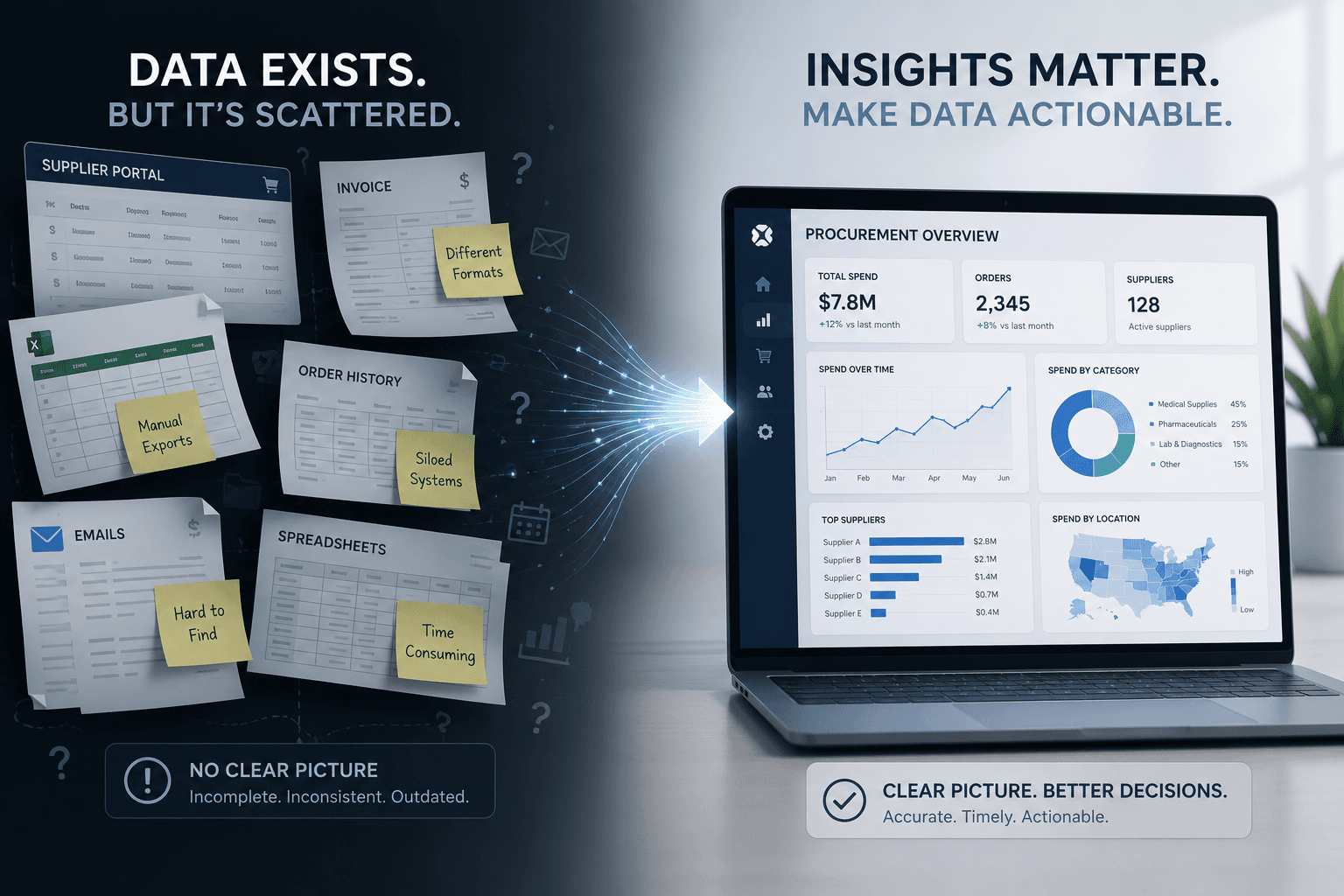
Most healthcare organizations think their purchasing costs are measured by what appears on an invoice.
But that’s only part of the story.
The true cost of procurement includes the hours spent placing orders, comparing prices, reconciling invoices, tracking spending, and answering questions about what was purchased and why.
Those costs rarely appear on a financial statement, but they affect every healthcare organization.
Purchasing happens everywhere
A typical healthcare organization may buy supplies from multiple distributors and specialty vendors.
One employee logs into one portal. Another uses a different supplier website. Invoices arrive from several vendors. Order histories live in separate systems.
Over time, purchasing becomes fragmented.
Each supplier may provide useful information about orders placed through their platform, but no supplier can show the complete picture.
As a result, organizations often struggle to understand total spending across all purchasing activity.
The data exists, but it is scattered
Most healthcare organizations are not lacking data.
They are lacking visibility.
The information needed to make smart purchasing decisions already exists. It simply lives in different places.
A practice administrator may know what was ordered from one distributor, but not what was purchased from three others.
A regional manager may know how one location is performing, but not how spending compares across every facility.
Ownership may receive reports, but those reports often require hours of manual work to prepare.
The challenge is not collecting more information.
The challenge is bringing it together.
Time becomes the hidden expense
Every purchasing workflow includes small tasks that seem insignificant on their own.
Logging into supplier portals.
Comparing orders.
Tracking down invoices.
Reviewing purchasing histories.
Answering questions from leadership.
Preparing reports.
Investigating unexpected expenses.
Individually, these tasks take minutes.
Collectively, they consume hundreds of hours every year.
Most organizations never calculate the true cost of that time.
Better visibility leads to better decisions
When purchasing data is centralized, organizations gain something they have never had before: context.
They can identify spending trends.
They can compare locations.
They can uncover opportunities for standardization.
They can understand purchasing behavior across the entire organization instead of within individual supplier portals.
Most importantly, they can make decisions based on complete information rather than partial information.
Healthcare organizations need visibility, not more portals
Supplier websites serve an important purpose.
They help organizations purchase products.
But healthcare organizations do not need another portal.
They need a better way to manage all of them.
The future of procurement is not forcing organizations to change suppliers.
It is helping them gain visibility across the suppliers they already use.
Because when organizations can see the complete picture, better purchasing decisions naturally follow.