Why Most Healthcare Procurement Data Goes Unused
Every order creates data.
Every purchase tells an organization something about supplier usage, product demand, pricing trends, inventory needs, and operational behavior.
But in healthcare, most procurement data is never fully used.
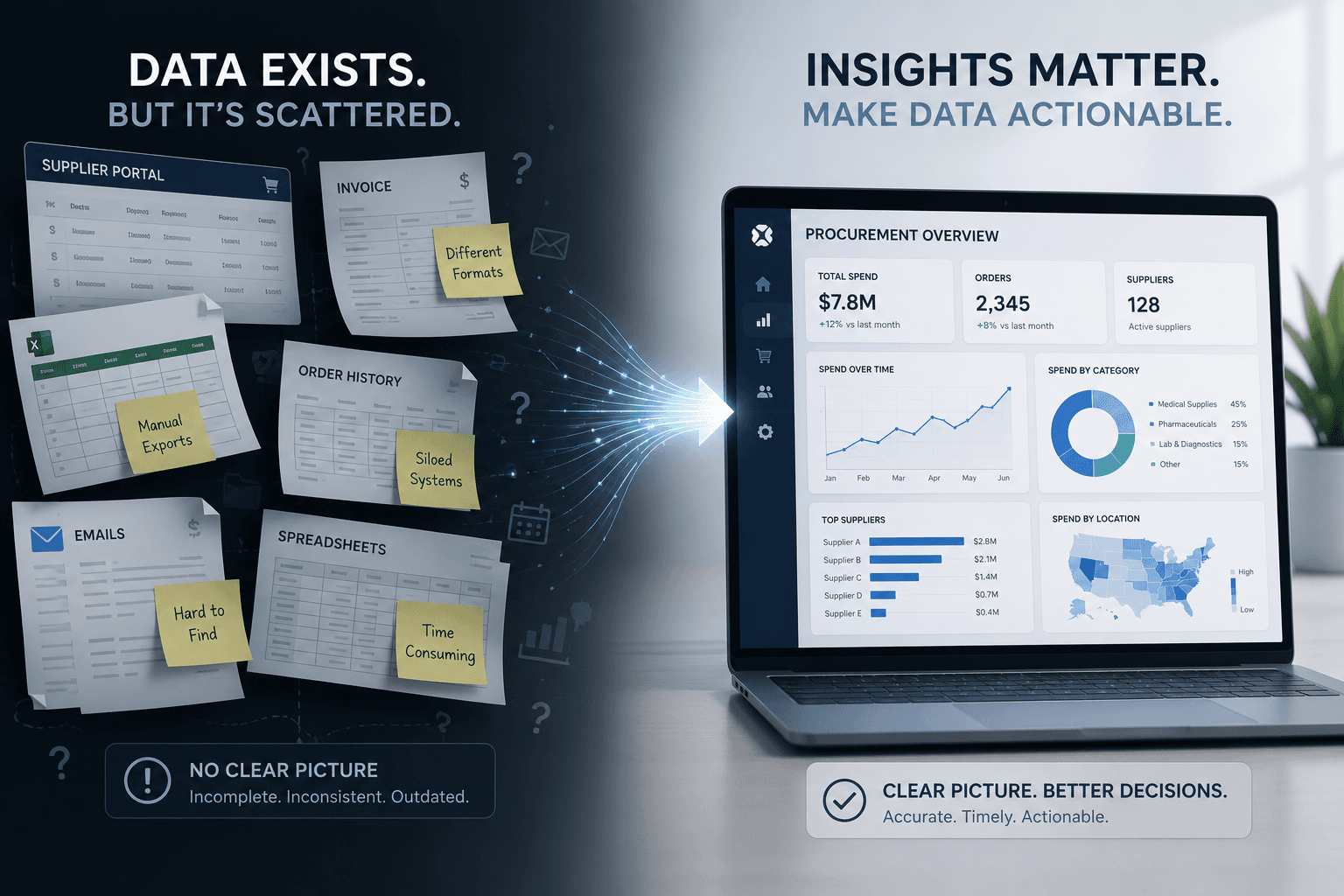
It exists across supplier websites, invoices, spreadsheets, purchasing reports, and accounting systems. The information is there, but it is often scattered, incomplete, or too difficult to analyze quickly.
That means many healthcare organizations are making purchasing decisions without seeing the full picture.
The problem is not lack of data
Most healthcare organizations already have more purchasing data than they realize.
They know what was ordered.
They know which supplier fulfilled the order.
They know the price paid.
They know who placed the order.
They know which location needed the product.
The challenge is that this information often lives in separate places. One supplier portal shows one portion of activity. Another supplier portal shows another. Invoices tell part of the story. Spreadsheets attempt to bring everything together, but usually require manual work to maintain.
The result is a fragmented view of purchasing.
Data without visibility has limited value
Procurement data only becomes valuable when it can be understood and acted on.
A list of orders is not enough.
Healthcare leaders need to understand trends. They need to see where spending is increasing, which locations are ordering more than expected, which products are being purchased repeatedly, and where there may be opportunities to standardize purchasing.
Without visibility, data becomes a record of what happened instead of a tool for improving what happens next.
Manual reporting slows everything down
Many organizations still rely on manual reporting to understand purchasing activity.
Someone exports order histories.
Someone collects invoices.
Someone updates a spreadsheet.
Someone prepares a report for leadership.
By the time the information is ready, it may already be outdated.
This creates a delay between purchasing activity and operational decision-making. In a fast-moving healthcare environment, that delay matters.
Better data leads to better decisions
When procurement data is centralized, patterns become easier to see.
A practice can identify products that are being ordered inconsistently.
A multi-location group can compare purchasing activity across facilities.
Leadership can see spending trends before they become problems.
Inventory teams can better understand usage and demand.
Purchasing becomes less reactive and more strategic.
Procurement data should work harder
Healthcare organizations should not have to fight their own data.
The information needed to make smarter decisions already exists. The next step is making that information easier to access, understand, and use.
Modern procurement software should help organizations turn purchasing activity into real operational insight.
Because when procurement data is finally visible, it becomes one of the most valuable tools a healthcare organization has.


