What Healthcare Organizations Should Expect From Procurement Software in 2026
Healthcare organizations should expect more from procurement software.
For too long, the industry accepted systems that were expensive, difficult to implement, and frustrating to use.
That standard no longer makes sense.
Modern software should be faster, simpler, more transparent, and more accessible. Healthcare teams should not need months of setup or extensive training to gain control over purchasing.
In 2026, procurement software should feel very different.
It should be easy to use
The best software does not require weeks of training.
Healthcare staff already have enough to manage. A procurement platform should make their work easier, not add another complicated system to learn.
Modern procurement software should be intuitive from the first login.
Users should be able to find products, place orders, review purchasing activity, and understand reports without needing a technical background.
If the software is hard to use, adoption suffers.
And if adoption suffers, the organization never gets the visibility it needs.
It should work with existing suppliers
Healthcare organizations have existing supplier relationships for a reason.
They may have pricing arrangements, preferred vendors, product history, purchasing habits, and distributor relationships already in place.
A modern procurement platform should not force organizations to abandon those relationships.
Instead, it should make them easier to manage.
The goal is not to replace suppliers. The goal is to centralize purchasing activity and create better visibility across the suppliers already being used.
It should support multiple locations
Many healthcare organizations operate across more than one location.
That creates additional complexity.
Different teams may order different products. Locations may have different needs. Managers may need visibility across the entire organization while still allowing local teams to operate efficiently.
Procurement software should support that structure.
It should allow organizations to manage purchasing by location, user, role, and permission level.
It should provide central visibility without eliminating local control.
It should deliver reporting automatically
Procurement reporting should not require hours of manual work.
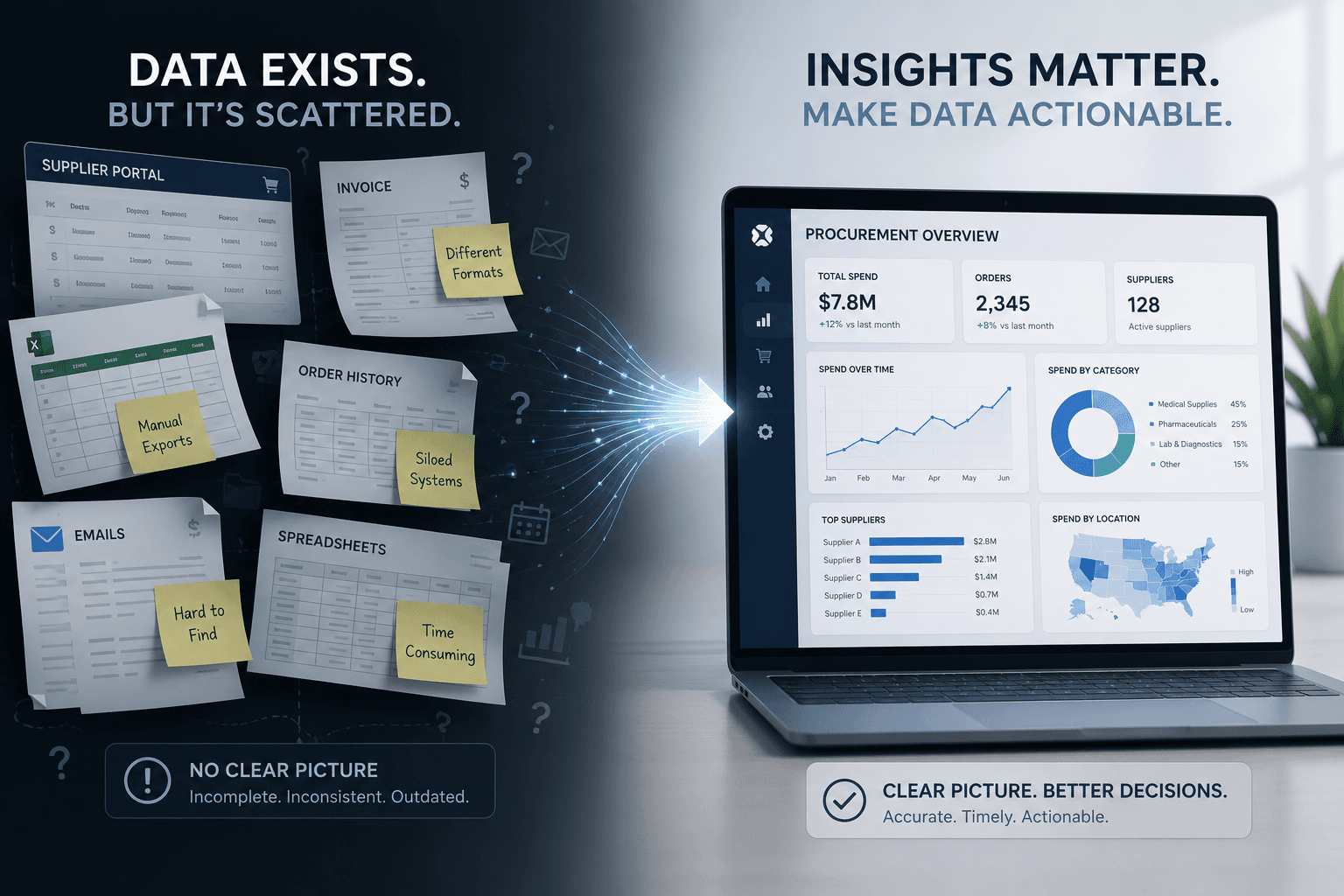
Modern systems should provide dashboards and insights automatically.
Leadership should be able to see spending trends, supplier usage, purchasing activity, and inventory-related information without waiting for someone to build a spreadsheet.
Reporting should be built into the workflow, not treated as a separate project.
It should be affordable
Enterprise-level procurement tools should not be reserved only for the largest health systems.
Modern technology makes it possible to deliver powerful software at a reasonable price.
Healthcare organizations of every size need better purchasing tools. Independent practices, specialty groups, surgery centers, and growing multi-location organizations should all be able to access modern procurement technology.
Affordability is not a luxury.
It is what makes adoption possible.
The standard has changed
Healthcare organizations should no longer accept procurement software that is slow, expensive, outdated, or difficult to use.
The new standard is simple:
Fast implementation.
Modern design.
Clear visibility.
Existing supplier compatibility.
Multi-location support.
Automated reporting.
Reasonable pricing.
That is what healthcare procurement software should deliver in 2026.